
Coffee station organizer compartments and storage capacity
Choose a coffee station organizer by usable capacity, not compartment count alone. The right layout holds your actual mix of pods, cups, lids and condiments while preserving hand access, refill clearance and counter space; extra compartments only add value when they reduce crowding instead of fragmenting usable space.

Capacity-fit decision assistant
Use the four criteria below to translate storage demand into an organizer profile. The result uses supply mix, refill demand, counter-space limits and access preference; it does not rely on seller capacity claims or live marketplace data.
A useful result identifies a layout profile and its main trade-off. Always verify the actual organizer dimensions against the pod, cup, lid or packet formats you intend to store.
Result
Select all four criteria, then choose Evaluate capacity fit.
Across coffee station organizers, usable capacity is the amount of storage that remains practical after allowing for item size, divider position, reach and refill clearance. The sections below compare compartment structures, supply-specific constraints and the trade-offs that determine whether a layout works during daily coffee preparation.
Compartment count and usable capacity in coffee station organizers
Compartment count is the number of separated sections created by drawers, tiers, trays or dividers, while usable capacity is the amount those sections can hold without blocking normal retrieval or refill access. Internal dimensions, divider position, supply shape and clearance determine whether the visible structure becomes practical storage.

Compartment count
Describes the visible number of separated sections. It tells you how storage is divided, not how much of that space can be used comfortably.
Usable capacity
Describes storage that remains reachable and refillable after accounting for supply dimensions, crowding, divider position and clearance.
Selection rule
Prefer the layout that preserves access after loading your real supplies. More compartments are useful only when they improve separation without wasting or blocking space.
Compartment layouts for separated coffee supplies
Compartment layouts determine how pods, cups, lids and condiments are separated, seen and reached. Two organizers with a similar footprint or section count can behave differently because open sections, drawers, tiers, slots and divided trays use space in different ways.

The most useful comparison is the relationship between separation style, access direction, visibility and stacking. The table summarises how each layout changes practical capacity.
| Layout form | Separation style | Access pattern | Capacity effect |
|---|---|---|---|
| Open sections | Exposed separation | Direct visibility and reach | Faster access, lower containment |
| Drawers | Hidden compartmentalization | Pull-to-access | Controlled storage, reduced visibility |
| Tiered racks | Vertical separation | Layered reach | Improved stacking, moderate access depth |
| Slots | Linear separation | Front-facing access | Organized upright storage |
| Divided trays | Segmented separation | Segmented reach | Efficient small-item grouping |
Use the layout form as a behaviour signal: open storage favours speed and visibility, while drawers favour containment; tiers use vertical space, and divided trays favour small-item separation.
Open caddies, drawers, tiered racks, and divided trays
Open caddies, drawers, tiered racks, and divided trays describe four layout forms used in coffee station organizers to separate coffee supplies through different access direction, visibility, and stacking behavior. Each form changes how items are reached, how vertical clearance is used, and how supplies are visually exposed or hidden during use.

These layout forms differ mainly in how they control access direction and supply visibility within the same storage footprint. An open caddy keeps items exposed for direct reach, while a drawer hides supplies and requires pull-out access with guided clearance. Tiered racks use vertical stacking behavior to separate items across levels, and divided trays segment smaller supplies with limited depth and structured placement.
- Open caddy: Keeps supplies exposed for direct top or side retrieval. It favours visibility and speed, but needs a clear hand path and provides less containment.
- Drawer: Uses pull-out access and hides supplies. It contains pods or small items well, but requires unobstructed pull clearance and adds an access step.
- Tiered rack: Uses vertical separation to place supplies on multiple levels. It can save counter area, but needs enough height and reach clearance for the upper and rear positions.
- Divided tray: Uses shallow segmented top access. It works well for packets, lids and other small items, but deep stacking can reduce the visibility that makes the tray useful.
Removable dividers and adjustable compartments
Removable dividers and adjustable compartments refer to internal organizer structures that allow section sizes to be changed by inserting, shifting, or removing divider pieces. They control how coffee supplies are separated by altering slot spacing and internal boundaries within the same unit. This adjustability can support different supply sizes, but only when the structure maintains enough stability during reconfiguration.

When coffee supplies vary in size or mix between pods, cups, and packets, removable dividers may improve adaptability by reshaping compartments to match the load. In contrast, fixed divisions may provide more consistent stability when items remain uniform, reducing internal shifting during use.
- Removable dividers: Let one compartment be resized or combined with another; stability depends on how securely the divider locks into its slot or channel.
- Adjustable compartments: Fit mixed supplies more easily because section size can change, but usable capacity changes with each divider position.
- Fixed divisions: Keep consistent spacing for uniform items, but cannot be widened when cups, packets or pod formats need more room.
- Slot spacing: Sets the adjustment increments and therefore how closely the compartment can match the stored item.
- Stability: The divider should stay in position during repeated loading and retrieval; shifting dividers reduce reliable separation.
Capacity ranges for pods, cups, lids, and condiments
There is no single useful capacity range for pods, cups, lids and condiments across different organizers because the items differ in diameter, height, shape and stackability. Capacity should be evaluated by supply type: pod count only for a specified capsule format, cup or lid count only for a compatible stack size, and packet capacity only where the compartment dimensions and retrieval path are known.
Pod-focused storage can use deeper or row-based compartments efficiently when the capsule format fits, while mixed-supply storage usually needs more segmented space for cups, lids, stirrers, packets and sachets. Higher storage density is not automatically higher usable capacity if stacked items block the next item or make refilling difficult.
Plan each supply around its own fit and refill pattern before combining it with other items. For a broader view of shared layouts, see pods cups and condiments storage.
| Supply type | Main capacity variable | Practical capacity loss | Verification point |
|---|---|---|---|
| Pods | Capsule format plus compartment depth/row spacing | Stacking or tight rows block direct retrieval | Confirm pod format, row/slot fit and refill access |
| Cups | Cup diameter plus stack height | Tall or tight stacks become unstable or hard to grip | Confirm vertical clearance and finger access |
| Lids | Lid diameter plus stack alignment | Mixed or misaligned stacks bind during retrieval | Separate compatible sizes and keep stacks aligned |
| Stirrers | Slot length/width plus bundle density | Dense bundles bury individual stirrers | Use a dedicated narrow section with easy top access |
| Sweetener packets | Compartment width/depth plus visibility | Packets compress, mix or disappear behind other items | Group by type and keep a visible retrieval edge |
| Condiment sachets | Sachet dimensions plus section depth | Mixed stacking hides sachets and slows selection | Use a shallow separated section where labels remain visible |
Pod counts and drawer capacity claims
A stated pod count is a conditional capacity claim, not a guarantee that every capsule format will fit. The realistic count depends on capsule shape, row or slot dimensions, whether pods are stacked, and the clearance needed to open the drawer and remove a pod.
When assessing these claims, variation in capsule format, drawer rows, and clearance can significantly change the realistic stored quantity. A higher claimed pod count may not translate into actual capacity if drawer depth is shallow or sleeve storage is split inefficiently, increasing mismatch risk between stated and usable capacity. Therefore, verification should focus on how pods, capsule formats, and drawer structure interact rather than relying on a single numerical claim.
- Capsule format: Confirm that the stated count applies to the pod or capsule shape you actually use.
- Layering assumption: Check whether the count assumes a single layer, stacked pods or a specific row arrangement.
- Drawer or slot dimensions: Verify that pod diameter, height and row spacing fit without binding or wasted gaps.
- Packaging assumption: Distinguish individual pod storage from sleeve or boxed storage; they use space differently.
- Access clearance: Leave enough vertical and horizontal clearance to open the drawer and remove pods without disturbing adjacent rows.
This chart shows the nature of pod count and drawer capacity claims, the key factors affecting real capacity, and the verification checks to assess realistic storage.

Cup, lid, stirrer, and packet storage capacity
Non-pod supplies use space differently: cups and lids are stack-based, while stirrers and packets depend more on slot dimensions, grouping and finger access. For these items, fit and retrieval path are more useful capacity measures than a single total count.
Capacity is lost when stacks lean, different lid sizes bind, packets compress into an unreadable mass, or small items become buried under larger supplies. The practical response is to keep each item type within a compartment geometry that supports both storage and removal.
| Supply | Main fit variable | Capacity-loss signal | Practical response |
|---|---|---|---|
| Cups | Cup diameter and stack height | The stack leans, compresses or reaches the available overhead clearance | Reduce stack height or use a section with more vertical clearance and a clear grip point |
| Lids | Lid diameter and alignment | Edges bind or mixed sizes interrupt one-at-a-time retrieval | Separate compatible sizes and keep each stack aligned |
| Stirrers | Slot length/width and bundle density | Individual stirrers are buried or difficult to pinch | Use a dedicated shallow or narrow section and avoid overpacking the bundle |
| Packets | Compartment depth and visible retrieval edge | Packets flatten, mix or disappear behind other items | Group by type and leave enough exposed edge for quick selection |
| Condiment sachets | Sachet dimensions and retrieval path | Mixed stacking obscures labels and slows access | Separate sachets from larger items and favour shallow visible storage |
This chart shows the key factors affecting storage capacity for non-pod supplies in a coffee station organizer, including cup and lid stacks, stirrer and packet groups, and condiment sachets.

Large-capacity organizers and storage trade-offs
A large-capacity organizer is useful when storage demand consistently justifies the extra compartments, tiers, drawers, width or depth. Its benefit is additional separated or reserve storage; its cost is usually more counter footprint, more reach distance or more access steps.
In shared or high-use settings, a larger organizer can reduce how often working stock needs to be replenished by holding more reserve pods, cups, lids, stirrers and packets. The trade-off is that extra tiers, drawers and depth can make items harder to see or reach, especially when frequently used supplies are stored behind reserve stock.
Choose larger capacity only when the added reserve storage is worth the space and access cost. If counter depth is tight or frequent-use items become hidden at the back or across several levels, a smaller layout with more direct access can provide more practical capacity.
Capacity trade-offs overview:
Large-capacity organizers shift value between storage expansion and usability costs. The comparison below outlines how key structural features influence storage gain versus trade-offs.
| Feature | Storage gain | Trade-off |
|---|---|---|
| Extra compartments | Improves separation of shared supplies | Can increase access steps during retrieval |
| Tiers | Expands reserve storage vertically | Reduces visibility and quick access |
| Drawers | Increases contained storage capacity | Adds access burden for frequent use items |
| Width expansion | Provides more surface area for mixed supplies | Increases counter footprint usage |
| Depth expansion | Supports higher refill interval efficiency | Can reduce reachability of rear items |
Extra compartments, tiers, and counter footprint
Extra compartments, tiers, drawers and side bins can improve separation, but they also change the organizer’s width, depth, height and access clearance. A storage feature is useful only if it fits beside the coffee machine and leaves the active preparation area and retrieval path unobstructed.
When extra compartments or layered tiers are introduced, storage efficiency may improve through better grouping of cups, lids, stirrers, and packets, but physical placement becomes more sensitive to available space. Increased vertical clearance requirements from tiers and forward reach adjustments from deeper drawers can affect how naturally items are accessed during routine use, especially when multiple supply types are stored together in compact work areas.
Footprint and capacity trade-off signals:
- Extra compartments: Increase internal storage divisions but can expand counter footprint and create crowding risk when placed near active prep zones.
- Tiers: Improve vertical storage layering but require additional vertical clearance and may affect reach angle near machines or walls.
- Drawer: Adds hidden storage capacity but needs pull space and can interfere with nearby equipment in narrow counter layouts.
- Side bin: Extends lateral storage for mixed supplies but increases counter width usage and may reduce available machine proximity space.
This chart shows how additional storage divisions like compartments, tiers, drawers, and side bins improve internal organization while also expanding counter footprint and creating space constraints.

Overfilled compartments and access loss
An overfilled compartment has crossed the point where added stock reduces access. Pods, packets, lids or stirrers may still fit physically, but capacity is no longer usable when the next item cannot be seen, gripped or refilled without moving other items.
Repeated blocking, shifting and re-stacking are practical signs that the compartment needs a lower working quantity, a different divider position or a different storage form.
Use the signals below to distinguish “full” from “overfilled”. Related overfilled compartment problems can also reveal when a layout is creating recurring access loss.
| Signal | Effect on usable capacity | Practical correction |
|---|---|---|
| Stacked pods block lower layers | Direct retrieval is lost even though more pods are present | Reduce stack depth or split pods across sections so the next pod remains reachable |
| Packets are compressed together | Labels and finger access disappear, increasing selection time | Lower packing density or divide packets by type |
| Lids bind or sit behind one another | One-at-a-time retrieval becomes unreliable | Reduce the stack or separate lid sizes and keep the retrieval edge clear |
| A drawer will not move freely | Internal crowding turns stored volume into access friction | Remove excess stock or redistribute it to another section |
| Stirrers are buried under larger items | Small supplies become effectively unavailable | Give stirrers a shallow dedicated slot or move them to the front |
| Clutter returns soon after refilling | The working quantity or layout does not match the retrieval pattern | Keep frequent-use items forward and reduce reserve stock in the active organizer |
Matching capacity to daily coffee station demand
Match capacity to daily working demand: the supply mix you actually use, how often it needs refilling, how many people share the station, how much counter space is available and how much reserve stock belongs at the point of use. The aim is not maximum volume; it is enough accessible stock to support normal turnover without crowding the station.
Use these demand signals together rather than treating any one of them as a complete capacity target.
- Supply mix: which pods, cups, lids, packets and condiments must be available at the station.
- Refill frequency: how often working stock must be replenished during normal use.
- User count: whether the station serves one person or repeated shared use.
- Counter limits: the width, depth, height and access clearance available around the coffee equipment.
- Backup quantity: how much reserve stock genuinely needs to remain at the point of use rather than elsewhere.
Capacity evaluation improves when demand signals are translated into structured selection criteria. Comparing usable volume against counter limits helps identify whether a setup may support daily turnover or create inefficiency under real conditions. A fit checklist for storage capacity helps structure this evaluation by linking physical constraints with supply behavior.
| Demand condition | Capacity profile | Prioritise | Main risk to avoid |
|---|---|---|---|
| Low turnover with tight counter space | Compact working-stock capacity | Direct access and minimal footprint | Oversizing the organizer and losing preparation space |
| Mixed supplies or shared use | Separated or adjustable working capacity | Clear grouping, visible retrieval and easy refilling | Many small sections that do not fit the real supply formats |
| High turnover with adequate counter space | Larger reserve capacity | Keep frequent-use items at the front and reserve stock behind or above | Deep or layered storage that makes daily items harder to reach |
| High turnover with tight counter space | Compact or vertical capacity with planned refills | Reach, machine clearance and refill flow | Forcing extra depth or tiers into a space where access becomes obstructed |
Right-sized capacity holds the normal working stock with clear access and manageable refills. Under-capacity shows up as repeated refill interruptions or crowding; excessive capacity shows up as unused sections, lost counter area or frequently used supplies being pushed deeper than necessary.
A compact station usually benefits from keeping only the working quantity close to the machine, while a shared or high-turnover station may justify more separated reserve capacity. In both cases, frequent-use supplies should remain the easiest items to see and reach.
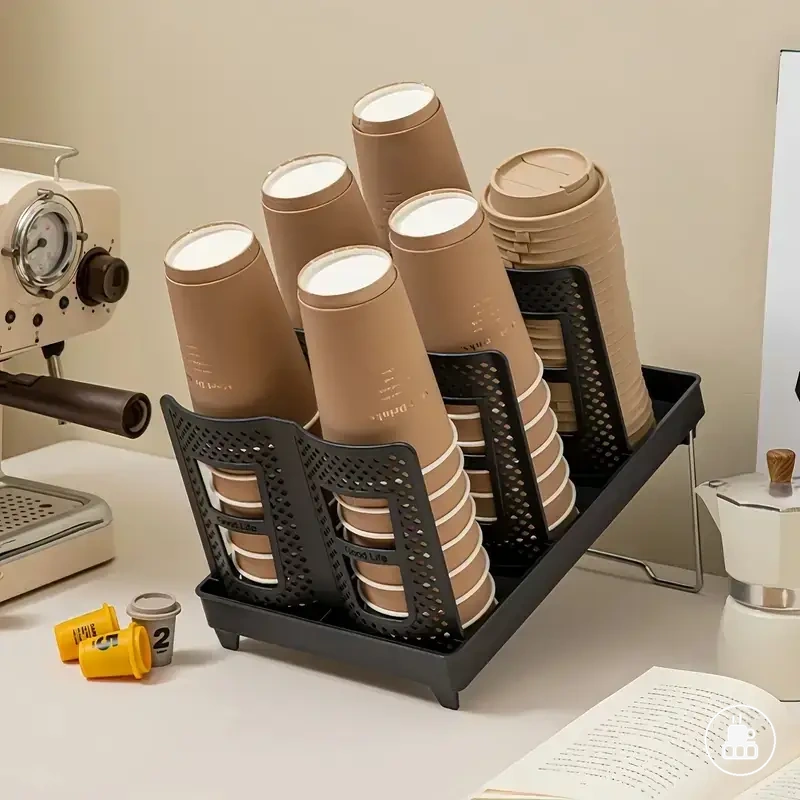
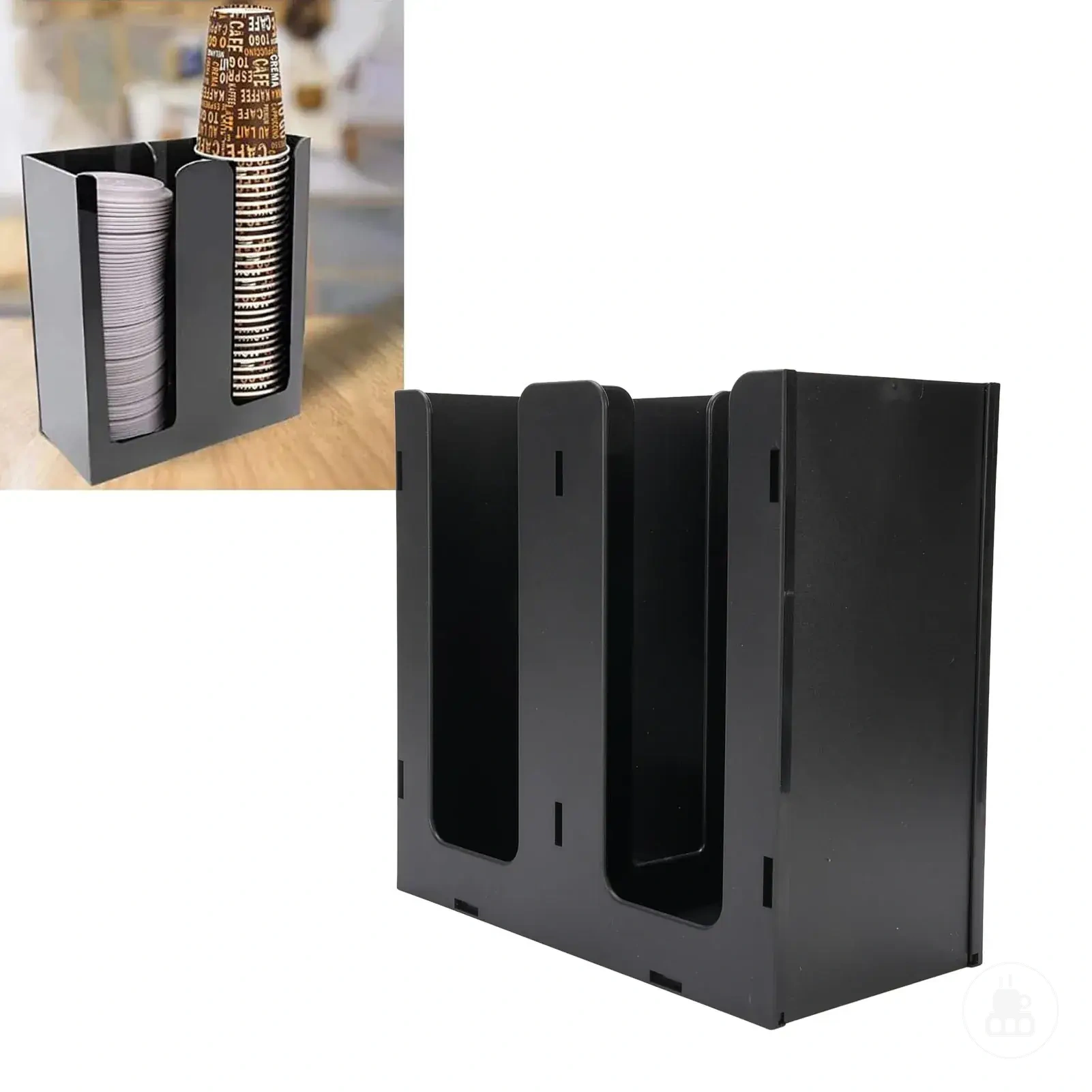
Product examples can make these organizer profiles easier to compare. Before following a product link, verify the actual dimensions, supply compatibility and access pattern against your station, and confirm current listing details on the third-party marketplace.



This chart shows the key demand factors and physical constraints that influence capacity matching, along with the resulting capacity outcomes of under-capacity and excessive capacity.

Visibility, reach, and refill access inside compartments
Visibility, reach and refill access determine whether stored volume remains usable during daily coffee preparation. A compartment can have spare physical space and still perform poorly if the next item is hidden, difficult to grip, blocked by a drawer path or awkward to restock.
Different compartment types influence access quality during daily coffee preparation based on how items are positioned and retrieved. Front visibility in open compartments typically supports faster identification and reduces retrieval delay, while drawers depend on drawer pull clearance that can increase friction when space is tight. Tiered storage changes tier height and hand reach requirements, which can improve organization but may slow access depending on placement. Refill openings and supply rotation also influence how smoothly items move through regular use, especially when multiple users interact with the same setup.
Blocked or reduced access lowers the practical usefulness of stored capacity because visibility, reach, and refill access are directly tied to usability. This effect becomes more noticeable when supply rotation does not match daily coffee preparation patterns or when compartment design limits natural hand reach. A setup workflow for stored supplies can help align compartment behavior with access needs when adjustments are required. In most cases, better access conditions help maintain consistent usability rather than increasing total storage alone.
Access condition checklist:
- Front visibility: The next pod, packet, lid or cup can be identified without moving unrelated items.
- Drawer pull clearance: The drawer can open fully without colliding with the machine, wall or neighbouring equipment.
- Tier reach: Frequently used items sit within a comfortable hand path rather than behind or above obstacles.
- Refill opening: There is enough space to add stock without dismantling the surrounding layout.
- Supply rotation: Older or earlier-loaded stock can be used before reserve items are buried or forgotten.
This chart shows how visibility, reach, and refill access determine whether stored capacity remains usable, including compartment type effects and a checklist of access conditions.
